Cyrus Chambers Jr.
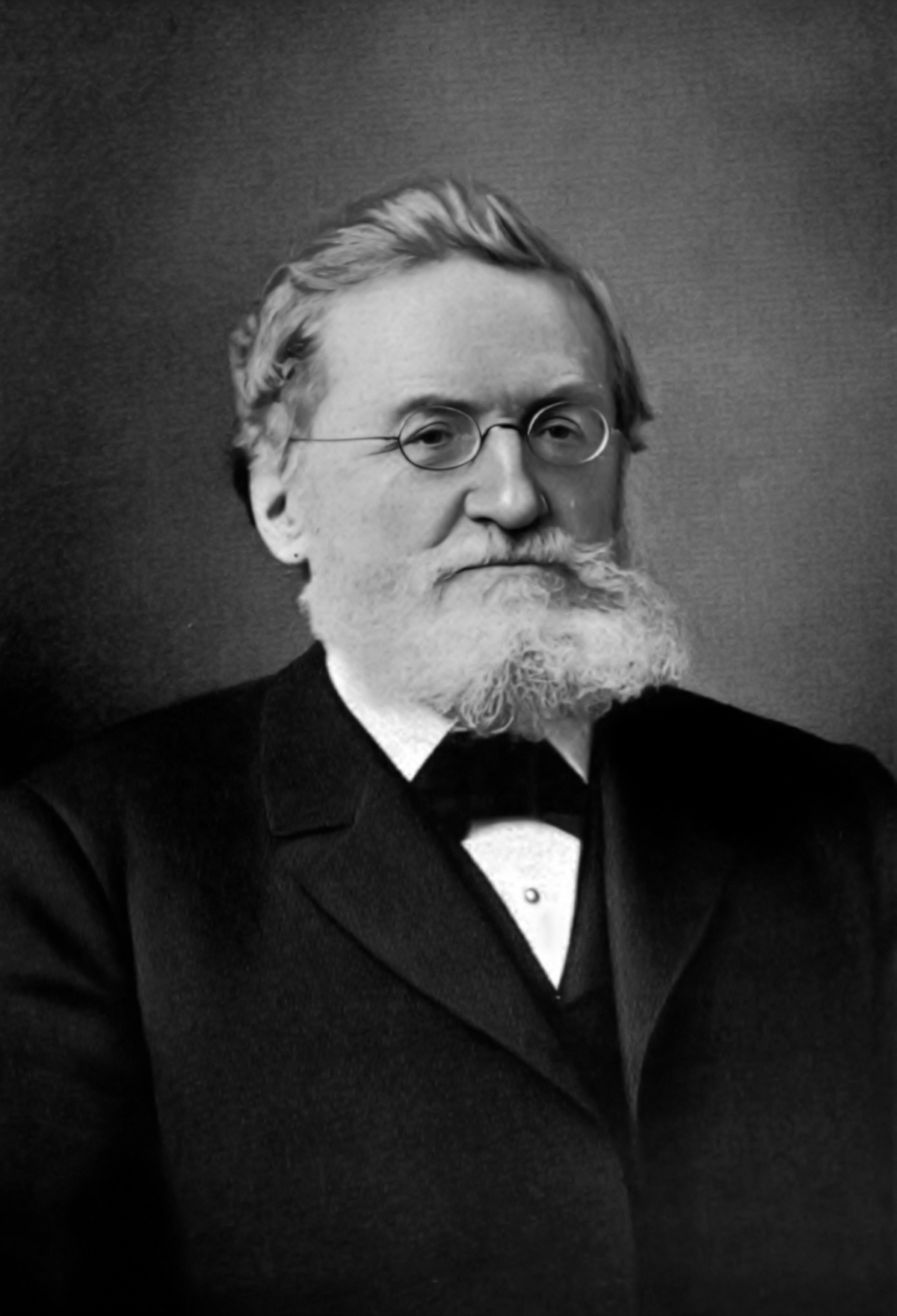
Cyrus Chambers, Jr. the ninth of thirteen children of John and Hannah Chambers, was born in 1833 at Bloomfield In Kennett Square.
His “ancestors… on both sides of the family were mill owners for many generations back.” Cyrus was born into a world of powered by water rapidly giving way to teh industrial revolution.
As a child he worked in the family woolen mill as a bobbin winder and advanced to loom operation, modifying equipment to suit his size and inventing practical aids when needed.
Family stories tell of Cyrus constructing carts, windmills, and water-wheels while still very young and producing a working model of sawmill and fulling machinery by about ten years of age. His younger brother John recalls:
Soon as he was old enough to handle a jackknife he made a model of the mill, complete in every detail. The overshot water wheel, the carding, spinning, and weaving machinery, the tilt hammers for fulling the cloth, and the sawmill were all represented. On a crank was a miniature monkey which worked with might and main to keep things going.
In nosing around for leather for belts he came across his father’s Sunday boots and proceeded to cut them into strips for his purpose. The leather was well tanned — so was the boy. The miniature mill attracted a great deal of attention from the patrons of the mill as well as from many others.
John also related this story:
In 1844 the Morse telegraph line was built between Baltimore and Washington, a full account of which was published in the New York Tribune with the Morse dot-and-dash alphabet. Cyrus, then a lad of eleven, absorbed the idea and at once proceeded to make a telegraph instrument, which he installed in the Lyceum schoolhouse on the north side of State Street in Kennett, opposite Martin Academy.
The line ran from the lower to the upper story, and when all was ready the townspeople were invited to see it in operation. Franklin Darlington was at the receiving end, and Cyrus sent him messages recorded by dot and dash on a roll of paper. This was the original method of reception, as telegraphers had not yet learned to read by sound. The experiment was a complete success, but the citizens pronounced it a clear case of “wire pulling.” This was the first telegraph operated in Pennsylvania.
Bloomfield Memories and records, 1920
Cyrus entered his brother Edwin’s dental practice in Kennett Square. He had wanted an apprenticeship with steam engine makers in nearby Wilmington, Delaware. His parents reportedly felt this arrangement cold spell trouble for a young man of Cyrus's disposition and wanted to keep him closer to home.
At that time dental work required grinding minerals and shaping materials manually. Cyrus made a machine to save he dudgery of doing it himself. He also devised a mechanical suction apparatus described as a “saliva pump,” considered an early precursor to the siphon later used routinely in dentistry.
While apprenticed to Edwin he found the time to build increasingly refined steam-engine models. One brass engine, heated by a spirit lamp, served as a stepping-stone toward his most famous miniature construction: A working model “Golden Miniature Steam Engine". It was assembled from more than one hundred fifty components fashioned largely of gold and silver; an object of extraordinary delicacy whose cylinder measured fractions of an inch and whose fasteners were scarcely visible without magnification.
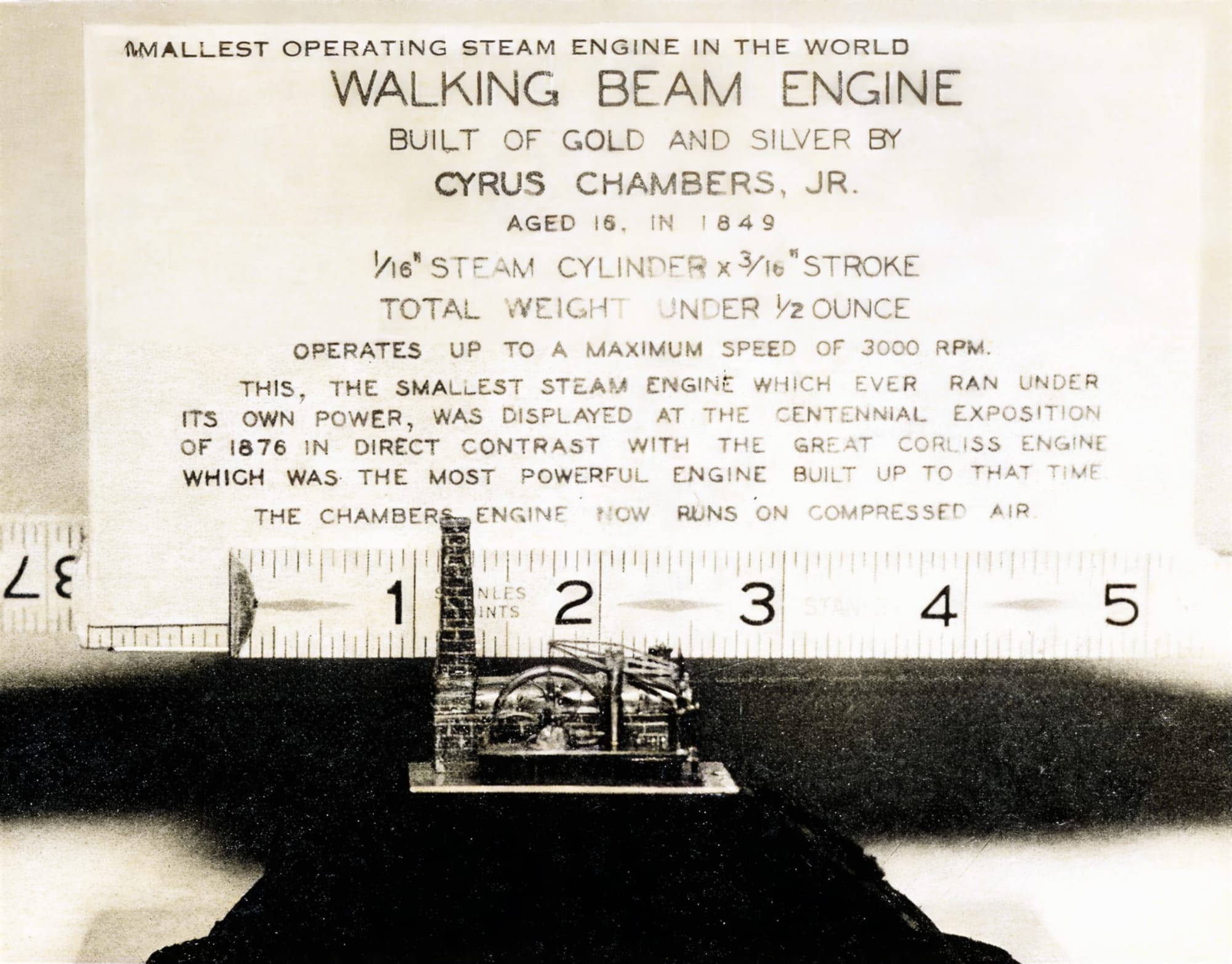
The piece drew significant attention; an agent representing P. T. Barnum reportedly offered one thousand dollars for it, an offer Cyrus refused, preferring to retain the engine as a personal achievement and heirloom.
When he was twenty Cyrus would invent the machine that launched the next family business; John tells it this way:
In 1853 came the great book-folders’ strike in New York, which paralyzed the book-publishing business. As the pages of books must be folded exactly in register, the publishers had to comply with the demands of the folder girls. Sister Sue was reading the article aloud to the family, and Cyrus’ interest was so aroused that he set to work to make a machine for folding book paper.
In less than a year he had a folder installed in J. B. Lippincott’s bindery. The Patent Office allowed him a patent... The folder business became very prosperous as time went on.
In 1857 Edwin withdrew from his profession and invested capital, forming Chambers Brothers & Company with Cyrus in Philadelphia, a move that underpinned Cyrus’s most consequential work. His brothers William, James, and Maris would all eventually have some share in the company.
Chambers Brothers expanded into multiple industrial fields: sewing machines, wartime equipment manufacture, and later large-scale clay-working machinery.
The next — and by far the most valuable — of Cyrus’ inventions was the brick-making machine of marvelous capacity. Its capacity is limited only by the ability to care for the product. In the Philadelphia pugnacious yellow clays the output is 125 bricks per minute, while in Chicago blue clay it will turn out 400 bricks in the same time. This invention was made in 1858.
Father was invited to see the first model brick machine in operation at the shop at Seventh and Cherry Street, Philadelphia. He sat by the little machine a long time in deep study. At last he looked up and said,
“Boys, I will stake all I am worth on that thing.”
Despite industrial prominence, family recollection preserves a more intimate portrait. He appeared in evening domestic scenes resting after work, and anecdotes from workers and relatives record a temperament capable of abrupt decision yet continuing engagement with employees and kin. A poetic family tribute later summarized his perceived legacy:
“The world, of course, is better for an inventive mind;
But Cyrus also did his share
To make the world more kind.”²¹
By the time of his death in July 1911, Cyrus Chambers, Jr. had moved from rural mill culture through apprenticeship with Edwin and into leadership in mechanical manufacturing. His career was shaped by collaboration with his brother, disciplined experimentation during professional training, and formative episodes — including construction of the miniature steam engine, invention within the dental workshop, and refusal of Barnum’s offer — that reveal the interplay of technical skill, ambition, and personal conviction that defined his life.